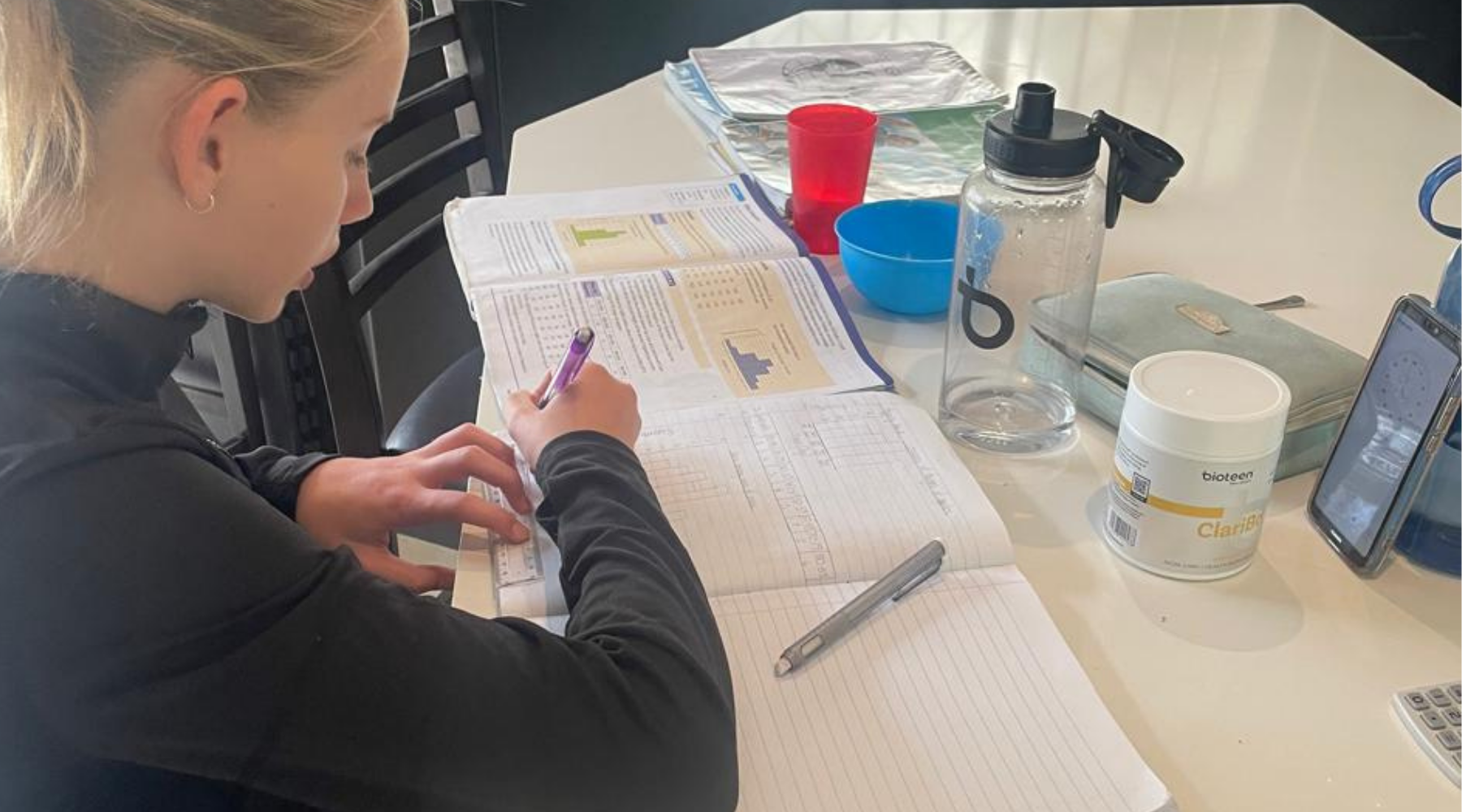
Matric Exam Season Is Not Just About Studying. Here Is What Actually Makes the Difference
The student who studies the hardest does not always perform the best.
There is a point during sustained study where more hours stops producing more learning and actually begins working against it. Understanding where that point is and what to do about it, is the preparation most matric students never receive.
This is the guide for parents who want to support their child through exam season in a way that gives them a genuine physiological advantage.
What Sustained Pressure Actually Does to the Teen Body
Stress is not the enemy of exam performance. Unmanaged, chronic stress is.
In the short term, cortisol, the body's primary stress hormone, is useful. It sharpens focus, increases alertness and provides the kind of motivational urgency that gets a teenager to open a textbook. This is healthy, functional stress.
The problem begins when that stress does not switch off.
When cortisol remains elevated for days and weeks without adequate recovery, it shifts from being a performance tool to a performance liability. Here is what sustained high cortisol actually does:
- Suppresses immune function: making your child more vulnerable to illness at exactly the worst time
- Disrupts sleep architecture: reducing the depth of sleep even when hours seem adequate
- Impairs memory consolidation: the process by which studied material is moved into long-term memory
- Increases emotional reactivity: making small setbacks feel catastrophic and regulation harder
- Depletes specific nutrients: particularly magnesium, zinc and B vitamins - faster than diet can replace them
The physical symptoms that show up during exam season, headaches, stomach discomfort, frequent illness, fatigue that sleep does not seem to fix, are not coincidental.
They are the nervous system signalling that the load has exceeded its current capacity.
Cognitive fatigue looks like laziness or lack of motivation from the outside. Neurologically, it is a regulatory signal. The brain is not refusing to work. It is telling you it has reached a temporary ceiling and needs to recover before it can function effectively again.
Ignoring that signal does not push through it. It extends it.
The Science of Study and Breaks
Here is what most students and parents are not aware of: focused attention typically begins to decline somewhere between 45 and 90 minutes of sustained cognitive work and rarely survives unbroken beyond that without a meaningful loss in quality.
More hours of study beyond this point does not equal more learning.
Research on deliberate practice consistently shows a ceiling of approximately 3 to 4 hours of genuinely focused cognitive work per day for most people - after which quality drops sharply, errors increase and retention falls significantly.
A student grinding through hour six of revision is not studying more effectively than a student who stopped at hour four and rested. In most cases they are studying considerably less effectively.
Structured breaks do not reduce study effectiveness. They restore it.
What the research supports:
- The brain integrates and consolidates information during rest, not only during active study
- Short breaks between focused sessions improve recall and retention compared to unbroken study blocks
- The quality of focused work in a rested brain consistently outperforms the quantity of unfocused work in a fatigued one
What a proper break actually looks like:
A break is not scrolling. Social media, news and video content keep the brain in a state of passive stimulation that prevents the genuine cognitive rest the prefrontal cortex needs to recover.
A useful break involves:
- Movement - even a short walk outside
- Food or water
- Something genuinely restful - music, a conversation, time in natural light
- Full disengagement from the study material
A practical structure for students - the Pomodoro method:
- 25 minutes of focused work
- 5 minute genuine break
- After 4 cycles - a longer break of 20 to 30 minutes
For students who can sustain longer focus windows naturally, a 45 to 90 minute block followed by a 15 to 20 minute break works on the same principle. The specific timing matters less than the discipline of stepping fully away when the break arrives and not treating scrolling as rest.
Sleep Is Not Optional
Read that again.
Becuase this is the section most matric students need to hear and the one most likely to be ignored.
Cutting sleep to study more is one of the most counterproductive decisions a student can make during exam season. Not because rest is more important than preparation, but because the preparation only consolidates during sleep.
Memory consolidation, the process by which studied material moves from short-term to long-term memory, depends critically on sleep. Research consistently shows that adequate sleep significantly improves retention and recall compared to equivalent time spent awake.
Studies in adolescents specifically have found meaningful improvements in declarative memory,the kind most relevant to exam performance, following sleep compared to the same period without it.
This means that everything your child studied during the day is processed, organised and stored during the night that follows.
A student who studies until 2am and sleeps for five hours is not just tired the next day. They are actively undermining the neurological process that determines how much of the previous day's work is actually retained and accessible when needed.
What consistently compromised sleep does to a matric student:
- Reduces the ability to concentrate and sustain focus the following day
- Impairs working memory - the capacity to hold and manipulate information during an exam
- Increases emotional reactivity and reduces stress tolerance
- Suppresses immune function - increasing illness risk during the exam block
- Reduces the effectiveness of everything studied the previous day by limiting consolidation
The minimum sleep recommendation for teenagers is 8 to 10 hours. During exam season, closer to 9 is the target - not a luxury, but a performance requirement.
Late-night cramming followed by poor sleep is not a study strategy. It is a cycle that compounds fatigue, reduces retention and leaves your child walking into an exam with less access to what they know than a rested brain would provide.
The studying happens during the day. The retention happens at night. Both matter equally.
Nutrition and Hydration During Sustained Mental Load
The brain is an organ. It runs on fuel. And like any organ under sustained high demand, what it receives determines how well it functions.
During exam season, nutrition is not a lifestyle consideration. It is a performance variable.
What the brain actually needs during high cognitive demand:
Stable blood sugar - not spikes and crashes. The brain depends on a consistent supply of glucose to maintain focus and emotional regulation. Meals that combine protein, complex carbohydrates and healthy fats provide sustained energy. Sugary snacks and caffeine-heavy options provide brief spikes followed by crashes that impair concentration and mood at exactly the wrong moments.
Magnesium - involved in over 300 enzymatic processes and directly relevant to nervous system regulation, stress response and sleep quality. Most teenagers are already running lower than optimal. Under exam stress, depletion accelerates.
B vitamins - essential co-factors for energy metabolism, neurotransmitter production and nervous system function. The B-vitamin complex is one of the most nutritionally demanding groups during sustained cognitive load.
Hydration - research suggests that even 1 to 2 percent dehydration may impair sustained attention and concentration. Attention is consistently among the cognitive domains most sensitive to hydration status, and most teenagers arrive at exams mildly dehydrated without realising it. Water intake during the study day is not incidental. It is directly linked to cognitive output.
Simple, practical food guidance for exam season:
- Breakfast every day without exception - blood sugar regulation starts here and sets the tone for cognitive performance through the morning
- Protein at every meal - eggs, chicken, fish, legumes, yoghurt - for sustained energy and neurotransmitter support
- Real food over convenience food where possible - the nutrient density difference is meaningful under high demand
- Snacks that combine protein and complex carbohydrates - not just sugar
- Eight glasses of water daily as a minimum - more on active or high-stress days
On days when time or appetite makes real meals unrealistic, MaxiMeal provides a practical complete meal option - protein, carbohydrates and key micronutrients in one serving, not a snack or a supplement
Nervous System Support - The Missing Piece of Exam Preparation
Almost all exam preparation focuses on content. Very little focuses on the system doing the learning.
The nervous system under chronic stress becomes measurably less efficient, not more. Concentration narrows. Emotional regulation deteriorates. The ability to retrieve stored information under pressure, which is exactly what an exam demands, is directly impaired by the same cortisol that the exam environment is generating.
Supporting the nervous system during exam season is not a soft or optional consideration. It is directly connected to how clearly your child can think and how reliably they can access what they know when it counts.
The functional ingredients that matter most:
Magnesium plays a direct role in regulating the stress response, supporting nervous system function and enabling the quality of sleep in which memory consolidation happens. Under exam conditions, where stress is sustained and sleep is frequently compromised, magnesium depletion is one of the most practically significant nutritional shortfalls. MgBoost provides a triple-magnesium blend in highly bioavailable forms with B6 and D3 as co-factors, designed specifically for adolescents with elevated demand.
L-Theanine supports a state of calm alertness by reducing the anxious overactivation that impairs clear thinking under pressure, without causing sedation or drowsiness. This distinction matters for exam performance, where the goal is a regulated, accessible mind rather than a sedated one.
GABA supports a calmer nervous system state and works alongside L-Theanine to reduce the mental noise that makes it harder to think clearly, recall under pressure and regulate emotion during high-stakes moments.
These ingredeints are present in Relaxify, which is formulated for nervous system downregulation and emotional balance during sustained stress. Relaxify is the stronger option when stress, anxiety and emotional overwhelm are the primary concern.
ClariCalm combines L-Theanine and GABA in a lighter daily formula specifically suited to calm focus - supporting your child's ability to filter distractions and stay composed during classroom study or revision, rather than managing acute stress or anxiety.
The distinction is meaningful: ClariCalm for daily composure and focus under ordinary pressure, Relaxify for the heavier lifting on nervous system regulation.
B vitamins support energy metabolism, neurotransmitter synthesis and nervous system function - all of which are elevated demands during exam season. In their methylated forms, they are absorbed and used more effectively, which matters when the body is already under load. All of Bioteen's formulations include vitamins and minerals in their most bioavailble forms.
Sleep support is an active recovery tool during exam season, not simply passive rest. SuperSleep is formulated to support sleep onset, sleep depth and nervous system recovery overnight, when memory consolidation happens and the cognitive and emotional repair the brain needs before the next day's demand begins again.
A Practical Pacing Guide for Exam Season
The most effective exam preparation is not last-minute - it is consistent.
Here is a simple framework for parents to share with their child.
6 to 8 weeks out
- Establish the study rhythm - focused blocks with structured breaks rather than long unbroken sessions
- Prioritise sleep now, before the pressure peaks, so the habit is already in place
- Get nutritional foundations in place - DailyMulti or SuperTonic daily, consistent meals, hydration
- Begin immune support - Immunergy daily, ColdBuster on hand for when symptoms
2 to 4 weeks out
- Tighten the routine and protect it - consistency is more valuable than intensity at this stage
- Add targeted nervous system support if not already in place - Relaxify for stress and anxiety, ClariCalm for daily focus and composure
- Add Learnergy for sustained mental energy and cognitive stamina on long study days
- For the sharper, shorter focus boost before a specific revision session or paper - ClariBoost
- Protect sleep aggressively - this is not the time to compromise it for extra revision hours
Exam week
- Maintain everything already in place - this is not the time to introduce anything new, change routines or make dramatic adjustments
- Focus on execution - the preparation has happened, now the system needs to be allowed to deliver it
- Keep meals consistent, keep hydration up, keep sleep protected
- Use SuperSleep to support sleep quality between papers when the nervous system is most activated
The One Thing to Remember
The student who arrives at exam day rested, regulated and properly fuelled has already done something most of their peers have not.
They have prepared the system that does the learning, not just loaded it with content.
Exam performance is not only a function of how much your child knows. It is a function of how effectively their brain can access what they know under pressure, on demand, across consecutive high-stakes days.
Sleep, nutrition, breaks and nervous system support are not separate from exam preparation. They are the preparation that makes everything else work.
PS: We've bundled up some of these products at 10% OFF - View them here
FAQs
Why does studying too much actually hurt exam performance?
Focused attention typically begins to decline between 45 and 90 minutes of sustained cognitive work, and research on deliberate practice consistently shows a daily ceiling of approximately 3 to 4 hours of genuinely focused study. Beyond this point, errors increase, retention falls and the quality of study drops significantly. Structured breaks restore cognitive capacity, they do not reduce it.
How important is sleep for exam performance in teenagers?
Sleep is critical. Memory consolidation, the process by which studied material moves from short-term to long-term memory, depends critically on adequate sleep. Research in adolescents specifically has found meaningful improvements in declarative memory following sleep compared to equivalent waking time. Cutting sleep to study more is one of the most counterproductive decisions a matric student can make.
What should a matric student eat during exam season?
The brain needs stable blood sugar, adequate B vitamins, magnesium and consistent hydration to function well under cognitive load. Practical priorities include breakfast every day without exception, protein at every meal, real food over convenience food where possible, and adequate water intake throughout the study day. On mornings when a full breakfast is not realistic, a complete meal solution covering protein, carbohydrates and key micronutrients helps maintain nutritional consistency.
How does dehydration affect exam performance?
Research suggests even 1 to 2 percent dehydration may impair sustained attention and concentration, the cognitive domains most sensitive to hydration status. Most teenagers are mildly dehydrated without realising it. Consistent water intake throughout the study day is directly linked to cognitive output and should be treated as a performance variable during exam season.
What is the difference between Relaxify and ClariCalm for exam support?
Relaxify is designed to actively downregulate the nervous system - it is the stronger option when stress, anxiety and emotional overwhelm are the primary concern, particularly during exam week itself. ClariCalm is a lighter daily formula combining L-Theanine and GABA specifically suited to calm focus - helping your child filter distractions and stay composed during study sessions and revision under ordinary pressure. ClariCalm for daily composure, Relaxify for heavier exam-week stress.
What is the difference between Learnergy and ClariBoost during exam season?
Learnergy is formulated for sustained mental energy, concentration and cognitive stamina across long study days and extended exam papers. ClariBoost is a more targeted option for a sharper, shorter focus boost before a specific paper or revision session. Both serve a purpose during exam season - Learnergy for the long game, ClariBoost for the focused burst.
Why does sleep matter more than extra revision hours during exam season?
Sleep is where memory consolidation, emotional regulation and cognitive repair happen. A student who sleeps 9 hours retains more of what they studied the day before than one who slept 5 hours and used those extra 4 hours for revision. The studying happens during the day. The retention and preparation for the next day happen at night. Both sides of that equation matter.